Fetal Bovine Serum Market to reach USD 2.31 Billion by 2035 at 5.8% CAGR
Fetal Bovine Serum Market to Surge from USD 1.30 Bn in 2025 to USD 2.31 Bn by 2035—By Cell & Gene Therapy Pipeline
Press Release Disclaimer: This is a press release distributed through the XPR Media network. It has not been independently verified by our newsroom.
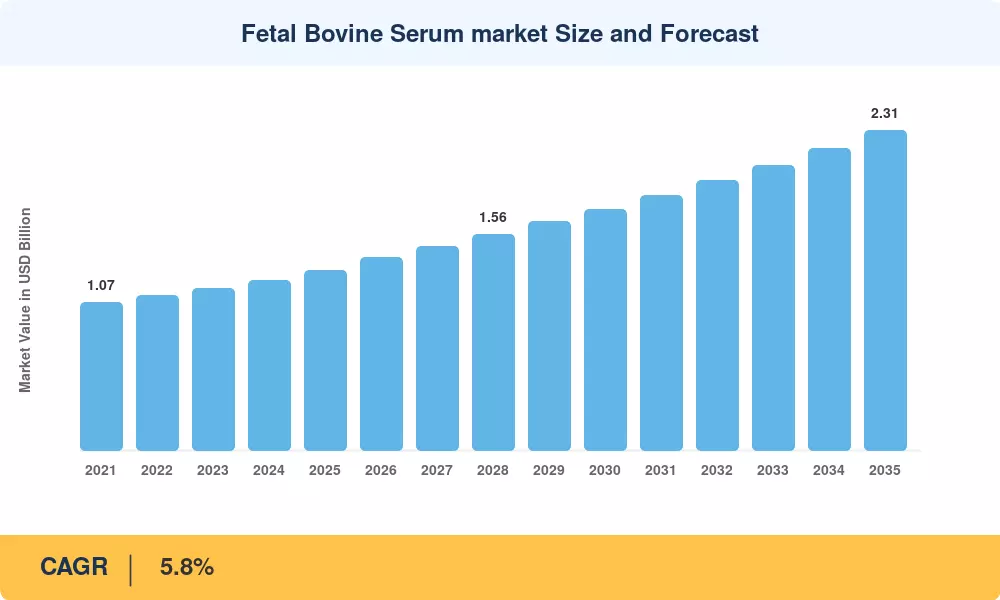

Fetal Bovine Serum Market to Surge from USD 1.30 Bn in 2025 to USD 2.31 Bn by 2035—By Cell & Gene Therapy Pipeline Expansion, Biopharmaceutical R&D Investment
NY, CA, UNITED STATES, August 27, 2026 /EINPresswire.com/ — As per Market Research Future, the global Fetal Bovine Serum Market size is projected to reach USD 2.31 Billion by 2035 from USD 1.30 Billion in 2025, at a CAGR of 5.8% during the forecast period 2026–2035. The market base was estimated at USD 1.30 Billion in 2025, with the first year of the forecast period (2026) valued at USD 1.39 Billion.
The 5.8% CAGR—anchored by structural shifts in biopharmaceutical R&D and raw material supply—is propelled by three converging forces: the cell and gene therapy pipeline, which now exceeds 3,200 active clinical assets globally, creating non-discretionary demand for qualified serum lots; the U.S. cattle herd dropping to roughly 87.2 million head in January 2025—its lowest level since 1951—tightening raw-material supply and reinforcing pricing power; and global biopharmaceutical R&D spending crossing USD 265 billion in 2024, underwriting steady serum consumption even as synthetic alternatives gain early traction.
Global regulatory bodies and industry associations are amplifying this momentum. The International Serum Industry Association (ISIA) accreditation scheme and EU regulatory criteria now demand full geographic traceability from abattoir to end user. The European Medicines Agency has strengthened TSE/BSE risk-mitigation documentation for serum used in the manufacturing of biologics, raising switching costs for purchasers. The Alliance for Regenerative Medicine reported over 1,700–2,000 active cell and gene therapy clinical assets globally as of late 2025. These forces are creating the procurement infrastructure and quality standards on which the Fetal Bovine Serum Market depends.
Request A Free Sample:
https://www.marketresearchfuture.com/sample_request/7377
Key Market Trends & Growth Drivers
Cell and Gene Therapy Pipeline Expansion
The Alliance for Regenerative Medicine reported over 1,700–2,000 active cell and gene therapy clinical assets globally as of late 2025. Each clinical-stage program requires validated FBS lots for cell expansion, differentiation assays, and potency testing—creating locked-in consumption that persists through multi-year development timelines. With more than 15 approved CAR-T products now on global markets, commercial-scale serum demand is compounding alongside the clinical pipeline.
Cattle Herd Contraction and Supply Scarcity
The USDA confirmed that U.S. cattle stood at 87.2 million head on January 1, 2024, and dropped further to 86.7 million head in January 2025, the lowest count since 1951. Prolonged drought conditions across key ranching states reduced calf crops in 2023 and 2024, directly constraining fetal blood collection volumes. Because FBS is a slaughter by-product with no synthetic substitute at scale, supply inelasticity translates directly to pricing power for integrated collectors.
Biopharmaceutical R&D Investment
Industry benchmarking data shows that global biopharmaceutical R&D spend was above USD 265 billion in 2024. This investment supports demand across the Fetal Bovine Serum Market since practically every mammalian cell-culture workflow, from early-stage screening to process development, uses FBS as the usual growth supplement. Serum usage per organization is increasing as large-pharma businesses ramp up pre-clinical capability to serve obesity, cancer, and autoimmune pipelines.
Regulatory Traceability Mandates
The ISIA accreditation scheme and EU regulatory criteria now demand full geographic traceability from abattoir to end user. These regulations add to compliance expenses for smaller dealers but benefit established suppliers who have invested in GPS-tagged collection, gamma-irradiation infrastructure, and blockchain-based chain-of-custody platforms. The European Medicines Agency has also strengthened TSE/BSE risk-mitigation documentation for serum used in the manufacturing of biologics.
Ask for Customization:
https://www.marketresearchfuture.com/ask_for_customize/7377
Market Segment Insights
BY PRODUCT TYPE
Charcoal/Dextran-Stripped Serum: Largest segment with 34.1% share in 2025, driven by demand from hormone-sensitive assay workflows. This grade removes endogenous hormones and growth factors that interfere with steroid receptor binding assays and endocrine research, making it indispensable for pharmaceutical screening workflows.
Stem-Cell-Qualified FBS: Fastest-growing product category at 6.7% CAGR (2026–2035) , propelled by the scaling of iPSC-derived cell therapy manufacturing and academic stem-cell research programs. These lots undergo additional testing for pluripotency maintenance and clonal efficiency, commanding premium pricing.
Heat-Inactivated: Growing at a 5.2% CAGR , driven by immunology and complement-sensitive assays.
Dialyzed: Niche segment for small-molecule metabolism studies.
BY APPLICATION
Biopharmaceutical Production: Largest application with 29.5% share in 2025, driven by monoclonal antibody and recombinant protein manufacturing.
Cell-Culture Maintenance & Expansion: Fastest-growing application at 7.2% CAGR (2026–2035) , reflecting the rapid build-out of CRO and CMO capacity, particularly across Asia-Pacific markets.
Vaccine Manufacturing: Significant segment at USD 0.22 Billion in 2025, driven by viral-vector and cell-based vaccine platforms.
BY END USER
Biotechnology & Pharmaceutical Companies: Dominant end-user with 57.4% share in 2025, reflecting their role as the primary sponsors of mammalian cell-culture-based drug development.
Academic & Research Institutes: Fastest-growing end-user category at 7.3% CAGR (2026–2035) , supported by expanded NIH, Horizon Europe, and national-level grant allocations.
CMOs/CROs: Significant segment at USD 0.16 Billion in 2025.
Read Detailed Insights:
https://www.marketresearchfuture.com/reports/fetal-bovine-serum-market-7377
Regional Outlook
North America — Dominant Market (~38.2% Share, 2025)
United States: Generates approximately 78.5% of North American revenue, supported by NIH annual research funding exceeding USD 47 billion in 2024 and the highest global concentration of cell-therapy manufacturing facilities.
Canada: Contributes 13.2% of regional share through government biotech grants and stem-cell research programs (Stem Cell Network, Genome Canada).
Mexico: Emerging market with 8.3% of regional share, driven by nascent CRO operations and cost-competitive labs.
Europe — Second Largest (28.5% Share, 2025)
Germany: Fastest-growing in the region at 5.4% CAGR, driven by pharma R&D and Fraunhofer institutes.
United Kingdom: Holds 22.8% of regional share through the Cell & Gene Therapy Catapult and MRC funding.
France: Contributes 16.4% of regional share through INSERM research programs.
Italy: Holds 10.7% of regional share through academic hospital research networks.
Spain: Contributes 8.1% of regional share through public biomedical research initiatives.
Nordic Countries: Hold 7.5% of regional share through Karolinska-linked research clusters.
Russia: Holds 4.2% of regional share through state-funded vaccine institutes.
Rest of Europe: Growing at 5.1% CAGR on expanding CRO presence.
Asia-Pacific — Fastest-Growing Region (6.7% CAGR, 2026–2035)
China: Fastest-growing in the region at 7.3% CAGR, driven by CRO/CMO build-out and NMPA biologics approvals (record 18 biologics approved in 2024).
India: Growing at 7.1% CAGR, driven by DBT biotech funding and vaccine manufacturing capacity.
Japan: Holds 19.6% of regional share through regenerative medicine regulation (PMDA) and forward-leaning conditional approval pathway.
South Korea: Holds 13.4% of regional share through biosimilar development clusters.
ASEAN: Growing at 6.8% CAGR on emerging lab infrastructure.
South America — Growing Presence (USD 0.08 Billion, 2025)
Brazil: Anchors the region at 58.3% of revenue through Fiocruz vaccine programs and cattle-origin supply.
Argentina: Contributes 24.7% of regional share through CONICET research and Pampas cattle herds.
Middle East & Africa — Emerging Opportunity (4.7% Share, 2025)
Saudi Arabia: Leads the region with 28.5% of regional share through Vision 2030 biotech investment (NEOM, Riyadh).
UAE: Holds 22.1% of regional share through healthcare free-zone lab expansion.
South Africa: Contributes 19.3% of regional share through SAMRC research programs.
Egypt: Holds 14.8% of regional share through National Research Centre initiatives.
Competitive Landscape and Recent Developments
The Fetal Bovine Serum Market exhibits medium concentration, with the top five suppliers holding an estimated 55–65% combined revenue share. The competitive structure bifurcates between vertically integrated global players—who control collection, processing, and distribution—and regional specialists competing on origin traceability and niche-grade expertise.
KEY COMPANIES AND RECENT MILESTONES
Thermo Fisher Scientific (May 2024): Reaffirmed its leadership in cell culture consumables by expanding distribution pathways for Gibco™ ISIA-traceable Fetal Bovine Serum across Asia-Pacific and European biomanufacturing hubs. Estimated ~14–18% revenue share.
Merck KGaA (MilliporeSigma): Broad life-science reagent ecosystem with Sigma-Aldrich FBS and process-grade serum. Estimated ~10–14% revenue share.
Cytiva (Danaher) (September 2024): Expanded the global reach of its HyClone™ characterized FBS line, leveraging scientific origin verification to guarantee authentic, low-risk Australian and New Zealand raw material sourcing. Estimated ~8–12% revenue share.
Corning Incorporated: Cell-culture consumables bundling with standard and specialty FBS. Estimated ~5–8% revenue share.
Biowest: Traceability-first positioning with origin-certified South American FBS. Estimated ~4–7% revenue share.
Bovogen Biologicals: Oceania supply-chain control with Australian/NZ-origin FBS. Estimated ~3–6% revenue share.
PAN-Biotech: European regulatory compliance with EU-sourced specialty sera. Estimated ~2–4% revenue share.
Moregate BioTech: Flexible sourcing and custom services with multi-origin FBS. Estimated ~2–4% revenue share.
HiMedia Laboratories: Cost-competitive FBS for emerging markets. Estimated ~2–3% revenue share.
Rocky Mountain Biologicals: Domestic origin premium positioning with U.S.-origin FBS. Estimated ~1–3% revenue share.
Recent Industry Developments:
European Medicines Agency (March 2024): Enforced strict compliance with EMA/410/01 Rev. 3 guidelines across European biopharma supply chains, requiring comprehensive viral safety and TSE/BSE risk assessment documentation.
Alliance for Regenerative Medicine (October 2023): Released sector data highlighting over 1,600 active cell and gene therapy clinical trials worldwide.
Future Outlook: 2026–2035
The Fetal Bovine Serum Market is projected to reach USD 2.31 Billion by 2035, growing at a CAGR of 5.8%, driven by cell and gene therapy expansion, biopharmaceutical R&D investment, and supply scarcity.
New opportunities lie in:
Specialty-Grade Premiumization: Charcoal/dextran-stripped and stem-cell-qualified FBS grades command pricing premiums of 40–80% over standard serum, and their share of total volume is rising as precision assays and regenerative medicine applications expand.
Asia-Pacific CRO/CMO Capacity Expansion: China’s biotech CRO sector grew at an estimated 18% CAGR between 2020 and 2024. India’s Biopharma SHAKTI initiative allocated INR 10,000 crore (approximately USD 1.2 billion) to strengthen biologics and biosimilars infrastructure.
Digital Traceability and Data Monetization: Blockchain-based lot-tracking platforms provide authenticated origin data, viral-testing certificates, and lot-performance analytics as a packaged value-added service.
Vaccine Platform Diversification: The proliferation of mRNA and viral-vector vaccine platforms has expanded the range of cell substrates requiring FBS supplementation during process development, with WHO estimating over 300 vaccine candidates in active development.
Emerging-Market Academic Infrastructure: Governments in Southeast Asia, the Middle East, and South America are increasing funding for university-level life-science research laboratories.
By 2035, the Fetal Bovine Serum Market is expected to demonstrate robust but supply-constrained growth, reflecting the non-discretionary nature of FBS in mammalian cell culture and the continued scaling of cell-based therapies.
More Related Research Insights:
https://www.marketresearchfuture.com/reports/healthcare-predictive-analytics-market-7549
https://www.marketresearchfuture.com/reports/epharmacy-market-6615
https://www.marketresearchfuture.com/reports/computational-biology-market-9216
https://www.marketresearchfuture.com/reports/mrna-cancer-vaccines-therapeutics-market-32508
https://www.marketresearchfuture.com/reports/blood-collection-market-7013
https://www.marketresearchfuture.com/reports/aptamers-market-6630
https://www.marketresearchfuture.com/reports/cardiac-biomarkers-market-8594
https://www.marketresearchfuture.com/reports/biohacking-market-5155
https://www.marketresearchfuture.com/reports/optical-coherence-tomography-market-1328
https://www.marketresearchfuture.com/reports/cbd-oil-market-7355
Market Research Future
Market Research Future
+1 855-661-4441
email us here
Legal Disclaimer:
EIN Presswire provides this news content “as is” without warranty of any kind. We do not accept any responsibility or liability
for the accuracy, content, images, videos, licenses, completeness, legality, or reliability of the information contained in this
article. If you have any complaints or copyright issues related to this article, kindly contact the author above.

Media gallery