Robotics Market Forecasted to Surpass USD 421.10 Billion with 18.2% CAGR by 2035
Robotics Market Size, Share and Research Report By Type (Autonomous Mobile Robots (AMRs), Automated Guided Vehicles
Press Release Disclaimer: This is a press release distributed through the XPR Media network. It has not been independently verified by our newsroom.

Robotics Market Size, Share and Research Report By Type (Autonomous Mobile Robots (AMRs), Automated Guided Vehicles (AGVs), Articulated Robots, Humanoids
NEW YORK,, NY, UNITED STATES, September 21, 2026 /EINPresswire.com/ — ➤ Robotics Market Overview
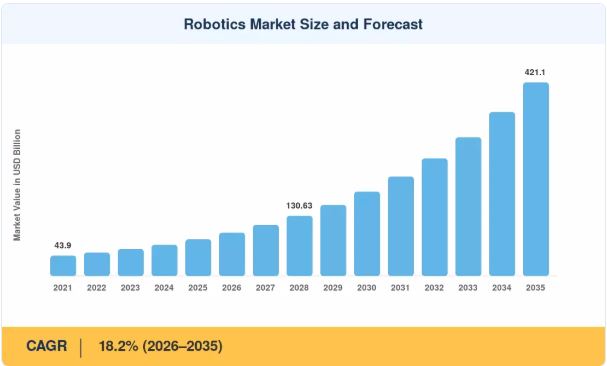
The Robotics Market closed 2025 at USD 79.10 billion and enters the forecast window at USD 93.50 billion in 2026, climbing to USD 421.10 billion by 2035 at an 18.2% CAGR. This expansion reflects structural labor shortages, rising deployment of AI-enabled and machine-vision-guided systems, and accelerating automation across manufacturing, logistics, healthcare, and warehousing.
Asia-Pacific commanded 35.1% of the Robotics Market in 2025, anchored by China’s large installed base of industrial robots and Japan’s leadership in precision assembly systems. Enterprises across the region continue to scale automated production lines to offset rising labor costs and support electronics and automotive manufacturing capacity.
Europe held the second-largest share at approximately 23.8% in 2025, supported by Germany’s Industrie 4.0 framework and growing adoption of collaborative robots in food processing and SME manufacturing. Businesses are increasingly deploying safety-rated cobots to expand automation without extensive facility reconfiguration.
The Middle East & Africa is advancing at the fastest pace, projected at a 22.9% CAGR across the forecast period. Sovereign-wealth diversification programs in Saudi Arabia and the UAE, along with construction and logistics-hub automation initiatives, are creating substantial opportunities for robotics vendors throughout the region.
Download Sample Pages of Research Overview –
https://www.marketresearchfuture.com/sample_request/4732
➤ Robotics Industry Landscape
Robotics systems combine mechanical hardware, sensors, controllers, and increasingly AI-driven software to perform tasks that range from repetitive material handling to complex surgical procedures. Rather than relying solely on manual labor, organizations are pairing skilled workforces with robotic platforms that can operate continuously, adapt to variable conditions, and integrate with broader digital operations.
The growing sophistication of sensor-rich, AI-enabled platforms is strengthening demand across industrial, service, and collaborative robot categories. Businesses increasingly operate mixed fleets spanning fixed industrial arms, mobile robots, and specialized systems, creating integration challenges involving safety, interoperability, and fleet-wide performance monitoring. Robotics vendors help enterprises coordinate these environments through cloud-based fleet management, predictive maintenance, and unified analytics.
The Industrial Robotics Market is a relevant topical authority keyword because industrial robots continue to anchor overall robotics demand, particularly across automotive, electronics, and metal-fabrication assembly lines. Six-axis articulated arms and precision-controlled systems remain central to high-throughput welding, painting, and palletizing operations.
The connection between industrial robotics and the broader Robotics Market illustrates how legacy fixed-sequence automation is evolving toward flexible, sensor-guided platforms. As manufacturers modernize production lines, they increasingly pair industrial robots with collaborative systems and AI-based quality inspection, creating opportunities for vendors that can serve both traditional and emerging automation needs.
Key Growth Drivers
Structural labor shortages remain a major growth driver for the Robotics Market. Aging populations across South Korea, Japan, and Western Europe, combined with persistent manufacturing job vacancies in the United States, are pushing enterprises to treat automation as standard operating insurance rather than a discretionary productivity upgrade.
AI and machine-vision integration is another significant factor supporting industry expansion. Reinforcement-learning controllers can adjust to part variability in real time, while vision-guided systems increasingly handle intricate bin-picking and quality-inspection tasks that previously required manual oversight, allowing robots to take on a broader range of unstructured tasks.
➤ E-Commerce and Warehouse Automation
E-commerce fulfilment growth is creating substantial opportunities because same-day and next-day delivery commitments make manual sortation increasingly uneconomical at scale. Logistics operators are expanding orders of autonomous mobile robots and goods-to-person systems to keep pace with rising order volumes and tighter delivery windows.
Warehousing and logistics strategies are also becoming more automation-intensive as businesses seek to reduce fulfilment costs and improve accuracy. Coordinating large robotic fleets across sprawling distribution centers can create challenges involving charging infrastructure, traffic management, and system integration. Robotics providers are addressing these challenges through centralized fleet orchestration, automated routing, and cross-platform monitoring capabilities.
➤ Artificial Intelligence and Platform Economics
Artificial intelligence is transforming robotics by enabling providers to generalize across tasks, forecast maintenance needs, and optimize fleet utilization without programming every scenario individually. AI-powered systems can analyze large volumes of operational telemetry and identify potential issues before they meaningfully affect production or fulfilment operations.
Robot-as-a-Service and subscription-based deployment models can also reduce manual capital barriers across provisioning, financing, and maintenance. As enterprises increasingly deploy AI-native robotic applications, demand for platforms capable of supporting intensive and variable workloads is expected to rise, creating an important intersection between robotics, cloud compute, and intelligent automation.
Buy Now Get Comprehensive Market Insights –
https://www.marketresearchfuture.com/checkout?currency=one_user-USD&report_id=4732
➤ Safety, Compliance, and Cybersecurity
Safety and regulatory compliance are increasingly central to enterprise robotics strategies. Organizations operating in automotive, healthcare, food processing, and other regulated sectors must protect worker safety and sensitive data while complying with industry-specific and regional requirements. Vendors can deliver force-limiting safety design, continuous monitoring, and compliance support to help enterprises meet evolving standards.
Cybersecurity is becoming particularly important as connected robotic equipment converges with enterprise IT networks, widening the attack surface for manufacturers. Updated regulatory frameworks, including the EU Machinery Regulation, are introducing stricter safety and cybersecurity requirements that are expected to drive a refresh cycle across installed robotic bases in the years ahead.
➤ Market Segmentation
The Robotics Market can be segmented across robot type, component, application, and end-user industry. Industrial robots remain the revenue backbone given their dominance in automotive and electronics assembly, while collaborative robots are recording the fastest growth as safety-rated designs open new floor-plan configurations for small and mid-sized enterprises.
Hardware continues to generate the majority of upfront revenue, though software is emerging as the fastest-expanding component as demand grows for offline programming, cloud-based fleet management, and AI-driven inspection tools. Logistics and warehousing represent the largest single application area, while medical and surgical robotics are advancing quickly as reimbursement pathways expand for robot-assisted procedures.
➤ Enterprise Adoption Trends
Large enterprises remain important customers because they operate complex, multi-site production and fulfilment networks that require advanced monitoring, safety governance, and integration capabilities. Robotics vendors allow these organizations to supplement internal engineering teams with specialized platforms and around-the-clock operational support.
Small and medium-sized enterprises are also becoming an increasingly attractive customer segment. Smaller manufacturers may lack the capital or in-house expertise required to deploy traditional automation, and Robot-as-a-Service models allow these organizations to access advanced robotic capabilities through predictable, subscription-based arrangements rather than large upfront capital outlays.
➤ Regional Insights
Asia-Pacific held 35.1% of the Robotics Market in 2025, reflecting its dense manufacturing base, government-backed robot density targets, and leadership in electronics and automotive assembly. Continued investment in domestic robotics manufacturing and rising adoption among small and medium-sized businesses are expected to sustain regional momentum throughout the forecast period.
North America and Europe together account for a substantial share of global revenue, supported by warehouse automation investment, reshoring incentives, surgical robotics adoption, and established industrial automation frameworks such as Germany’s Industrie 4.0 program. Demand for cybersecurity-hardened and safety-certified robotic systems remains strong across both regions.
The Middle East & Africa is developing as an important growth opportunity, projected to expand at a 22.9% CAGR through 2035. Sovereign-wealth investment programs, construction-linked automation initiatives, and logistics-hub modernization are increasing infrastructure requirements and creating additional demand for robotic platforms across the region.
➤ Emerging Opportunities
One of the most significant opportunities involves robotics platforms for AI and data-intensive workloads. Businesses increasingly need specialized robotic systems capable of supporting machine learning, real-time analytics, and large-scale automated data processing. Providers that can optimize these workloads while controlling costs can create differentiated offerings within the broader robotics ecosystem.
Another opportunity is the development of industry-specific robotic solutions. Healthcare, agriculture, retail, manufacturing, and defense organizations have different compliance, safety, performance, and operational requirements. Providers that combine robotic hardware with sector-specific software and services can offer more targeted solutions and build stronger long-term enterprise relationships.
➤ Key Challenges
Despite strong growth potential, the industry faces several challenges. High upfront capital expenditure for traditional robotic cells can extend payback periods for smaller manufacturers, making financing structures and cost management critical requirements. Enterprises may also encounter integration complexity, skill shortages among qualified robotics engineers, and inconsistent safety standards across jurisdictions.
Cybersecurity and data protection remain ongoing concerns as robotic equipment becomes more connected. Vendors must maintain strong governance and security practices while ensuring that operational data is protected across increasingly distributed deployments. Service interruptions can also carry significant consequences, making reliability, redundancy, and rapid technical support essential components of successful robotics offerings.
➤ Future Outlook
The Robotics Market is expected to maintain steady expansion as enterprises increasingly rely on automated systems for mission-critical production, fulfilment, and clinical operations. Growth from USD 79.10 billion in 2025 to USD 421.10 billion by 2035 represents a substantial increase in demand for industrial, collaborative, and AI-enabled robotic platforms.
Future development will increasingly center on AI-native autonomous operations, platform-based ecosystems, and energy-efficiency mandates. Providers that can combine technical expertise with strong cybersecurity, cost optimization, compliance capabilities, and flexible service models will be well positioned to capture long-term opportunities across manufacturing, logistics, and healthcare.
Browse Full Report Details –
https://www.marketresearchfuture.com/reports/robotics-market-4732
➤ Key Takeaways
The Robotics Market is being shaped by structural labor shortages, AI and machine-vision integration, e-commerce warehouse automation, and expanding safety and compliance requirements. Asia-Pacific remains the leading regional contributor, while the Middle East & Africa demonstrates the strongest growth potential and Europe benefits from established industrial automation frameworks.
The integration of AI, platform economics, and Robot-as-a-Service models will increasingly redefine robotics deployment. At the same time, related technology areas such as the Industrial Robotics Market demonstrate the growing requirement for flexible, sensor-guided, and intelligent automation environments. As businesses prioritize resilience and operational efficiency, robotics is expected to become an increasingly strategic component of enterprise operations.
➤ Frequently Asked Questions
Which cobot safety standard should procurement teams prioritize when evaluating vendors?
ISO/TS 15066 defines force and pressure limits for collaborative operation and remains the benchmark globally. Vendors whose systems carry third-party ISO/TS 15066 certification reduce buyer liability exposure and simplify facility insurance approvals
What minimum robot density indicates a factory has reached automation maturity?
IFR benchmarks suggest 150 robots per 10,000 manufacturing employees as the threshold where automation yields consistent productivity gains. South Korea leads globally at over 1,000, while most emerging economies remain below 30
➤➤➤ Industry Analysis Reports by Market Research Future:
Consumer Robotics Market-
https://www.marketresearchfuture.com/reports/consumer-robotics-market-5068
Collaborative Robots Market-
https://www.marketresearchfuture.com/reports/collaborative-robots-market-6708
Indoor Robots Market-
https://www.marketresearchfuture.com/reports/indoor-robots-market-6915
Indoor Farming Robots Market-
https://www.marketresearchfuture.com/reports/indoor-farming-robots-market-8616
Programmable Robots Market-
https://www.marketresearchfuture.com/reports/programmable-robots-market-6840
Telepresence Robots Market-
https://www.marketresearchfuture.com/reports/telepresence-robots-market-7058
Soft Robotics Market-
https://www.marketresearchfuture.com/reports/soft-robotics-market-8007
Robotic Process Automation For Smartphone Manufacturing Market-
https://www.marketresearchfuture.com/reports/robotic-process-automation-for-smartphone-manufacturing-market-5219
Mobile Robots Market-
https://www.marketresearchfuture.com/reports/mobile-robots-market-21851
Assistive Robotic Market-
https://www.marketresearchfuture.com/reports/assistive-robotic-market-24582
Market Research Future
Market Research Future
+1 855-661-4441
email us here
Legal Disclaimer:
EIN Presswire provides this news content “as is” without warranty of any kind. We do not accept any responsibility or liability
for the accuracy, content, images, videos, licenses, completeness, legality, or reliability of the information contained in this
article. If you have any complaints or copyright issues related to this article, kindly contact the author above.

Media gallery